
Safety management in an industrial ozone project: connect the protective layers
Safety management for an industrial ozone installation connects the physical process with measurements, operating decisions and human responsibilities. The useful question is how the site identifies an abnormal condition and brings the installation to its agreed state. That needs to be designed across the whole system.
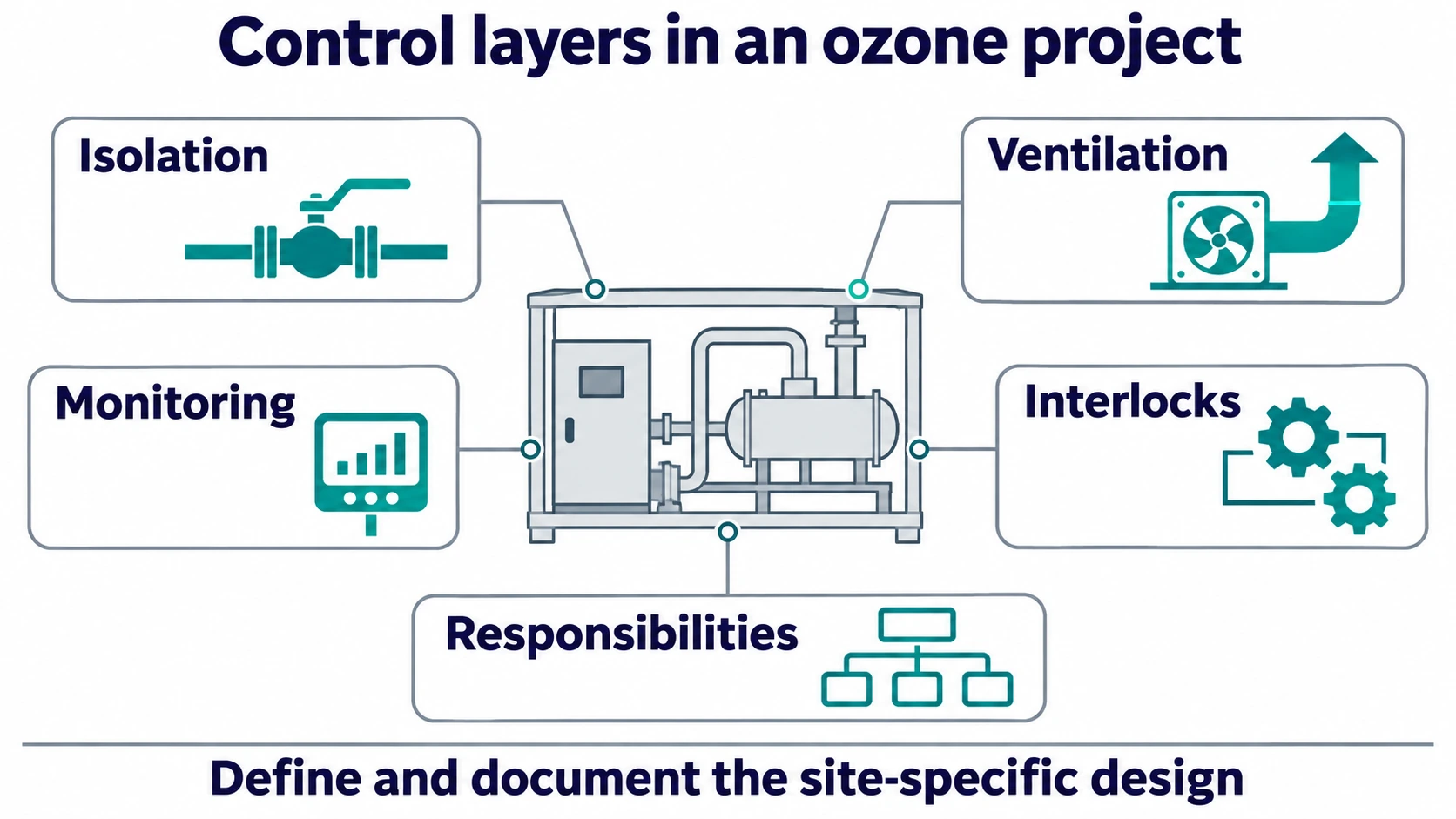
Follow the possible emission routes
Start with the ozone source and trace the gas through delivery, contact and outlet treatment. Include joints, sample connections, maintenance openings and gas separated from water. Mark neighbouring spaces and other systems that could provide a route beyond the intended process boundary.
A water application still has a gas-handling duty. Ozone supplied to the contact stage is not necessarily all consumed there. The outlet arrangement and any ozone-destruction equipment require a defined duty and suitable installation conditions.
Assess the layers as a connected design
Containment, ventilation, confirmed monitoring and access arrangements serve different functions. Their effectiveness depends on the installation and its operating states. Document the assumptions each layer relies on, including utilities and maintenance availability.
Materials also need assessment for the actual conditions. A general material name does not confirm every seal, coating or assembled component. The project should identify the applicable equipment documents and the party responsible for checking compatibility.
Turn signals into agreed responses
A measurement becomes useful when the required action is defined. System controls should distinguish normal process variation, an instrument fault and a condition requiring a protective response. The operator must be able to understand the resulting equipment state.
| Design question | Record required |
|---|---|
| What condition is monitored? | Location, medium and confirmed instrument duty |
| What response follows? | Approved control narrative and test method |
| Who handles the event? | Assigned operating responsibility |
| How is recovery authorised? | Site-specific procedure and recorded decision |
Test an abnormal operating state
Consider an illustrative installation in which the process-water circulation becomes unavailable while the generating package remains powered. The team must resolve permissions for gas delivery, management of remaining gas, operator information and the conditions for recovery.
This is a design review question, not a recommendation to simulate a fault on operating equipment. Commissioning tests should follow an agreed plan with appropriate responsibilities and conditions. Their records should demonstrate the intended response of the connected installation.
Separate process evidence from hygiene evidence
A concentration record can demonstrate a measured condition at its specified location. It does not establish that an entire room is sterile or that every target substance has been removed. A hygiene objective requires its own defined method and result.
Smell is unsuitable as the basis for a concentration measurement or a decision about access. Exposure criteria and operating procedures require the relevant site assessment and applicable requirements; a universal time or concentration cannot replace that work.
Make the handover usable
The handover should connect final drawings, instrument identifiers, tested control logic, operating instructions, maintenance responsibilities and incident records. The system overview and technical-documents section support those discussions without replacing the site-specific documentation.
To start an assessment, send a short description of the process and its location. A tailored technical discussion can then establish the required design information and the specialist responsibilities for the project.