
Adding an ozone-water stage to a food line: specify one operation well
A food-line project becomes easier to assess when it concerns one defined operation. Washing a raw material, rinsing equipment and treating recirculating water are different duties. Choose the operation first, then establish how an ozone-water stage could fit its process, hygiene and product-quality requirements.
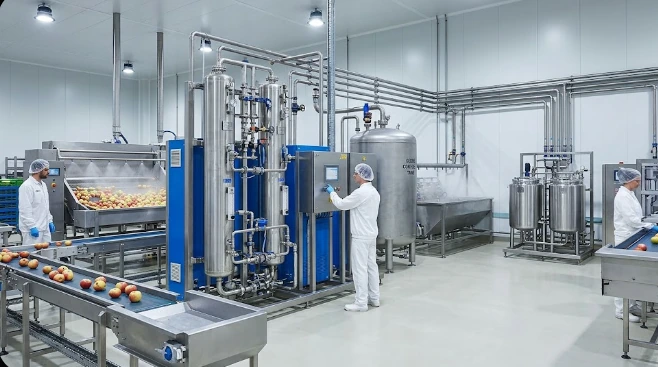
Draw the operation within the line
Identify the inlet, contact location, outlet and next production step. Record whether water passes through once or recirculates. Include the points where product, equipment and personnel interact with the water circuit.
For an illustrative rinsing installation, a separate treatment skid serves an existing loop. The project team must establish the return route, changing water load and conditions that permit treatment. A catalogue photograph cannot resolve those connections.
Specify the water and production duty
Document water flow, temperature, source and relevant analyses. Relate those records to product throughput and production periods. The organic load later in a run may differ from the initial condition, particularly in a recirculating operation.
A proposed ozonated-water system must be assessed for the actual duty and configuration. Its suitability for one industrial sector does not establish suitability for food contact. Request the relevant equipment, material and application documents.
Define the mechanical supply boundary
The integration scope should show dosing and mixing equipment, contact arrangements, pumps, pipework and isolation responsibilities. Identify who supplies and connects each item, including cleaning access and drainage where required.
| Boundary | Question to resolve |
|---|---|
| Water circuit | Where are treatment and return connected? |
| Food-contact components | Which documents support the actual materials and use? |
| Cleaning | How is the added equipment included in the site’s procedure? |
| Gas handling | Where can ozone leave the water, and how is that managed? |
Connect control to production conditions
A suitable dissolved ozone analyser provides a reading at its specified water point. Decide how the sample is taken and what the reading is intended to control. The location matters when water composition and contact conditions change.
System controls must fit production, cleaning, standby and abnormal states. Agree permissions, alarms and the response to unavailable flow or invalid measurements. The final control description should be understandable to the line operator.
Agree acceptance with the quality team
Separate the water condition from the product result. A stable residual does not establish a microbiological outcome, an acceptable sensory result or suitability for the next step. Define baseline sampling, comparison conditions, methods and product-quality checks before testing.
Keep changes to other cleaning or disinfection steps outside the assumption list. Any proposed change needs its own evidence and approval within the site’s process. The food-processing overview provides broader context without establishing a universal treatment permission.
Start with the operation that needs attention
The first discussion can stay short. Send the product or operation, the current problem and the site location. Existing water records and a simple line drawing can follow through a tailored technical questionnaire.
That information allows the project team to establish the scope for a trial, integration and individual pricing, with engineering and quality working from the same operation definition.