
After a fire in an industrial building: where an ozone assessment belongs
After a fire, an industrial operator faces several connected decisions: which areas are damaged, what contamination is present, which materials can remain and how production can eventually resume. Any assessment of ozone belongs within that specialist restoration plan, with a clearly defined question and evidence boundary.
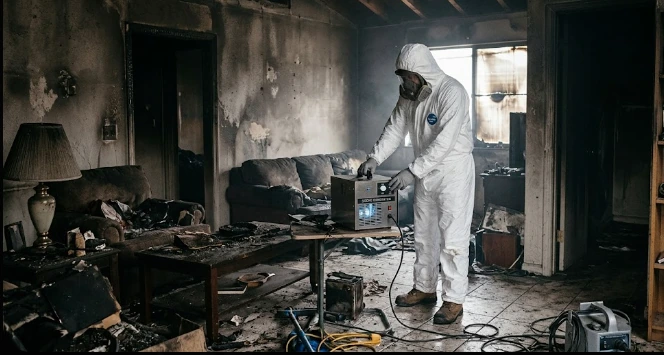
Separate restoration tasks before discussing treatment
Structural condition, electrical integrity, soot removal and damaged-material handling require their own assessments. The restoration team should establish the affected materials and the work needed before considering an additional odour intervention.
Odour is one observation within that review. Its intensity does not identify every combustion product or establish the condition of the building. A reduction in smell should remain separate from decisions about contamination, equipment condition and readiness for use.
In an illustrative production site, smoke reaches a packing area through a connected ventilation route. The investigation needs to follow that route and identify affected surfaces and materials. Focusing only on the room where the smell is strongest would leave the connected area unresolved.
Write a bounded intervention question
After the relevant cleaning and material work, the team may investigate a remaining problem. Define the zone, its condition, the intended outcome and the methods for assessment. Establish which restoration responsibilities remain outside the proposed treatment scope.
| Workstream | Evidence for the restoration record |
|---|---|
| Damage and contamination | Specialist findings and affected-area record |
| Cleaning and materials | Completed work, retained materials and unresolved items |
| Additional intervention | Specific objective, configuration and assessment method |
| Handover | Responsible sign-off and conditions for the next use |
That scope lets procurement compare a defined service or equipment duty. It also gives the restoration lead a clear basis for judging whether another method or further source work is more appropriate.
Coordinate the zone, equipment and controls
An ozone assessment requires a project-specific arrangement for isolation, connected spaces, monitoring and remaining gas. The control system should reflect the agreed permissions and abnormal-state responses, with responsibilities assigned across the site and treatment package.
If ozone-destruction equipment is proposed, confirm the actual gas duty and connections. The design must address its relation to ventilation and the process, rather than treating a catalogue component as a guarantee for every area.
Retained materials and equipment also need compatibility assessment for the intended conditions. The restoration plan should preserve the distinction between evaluating an additional process and repairing or replacing fire-damaged components.
Use evidence to close the restoration stage
The intervention record should describe the starting condition, work completed, operating configuration and actual findings. Keep odour observations, concentration measurements and any separate contamination analyses in identifiable evidence lines.
Handover remains a site-specific decision by the responsible parties. This assessment provides no universal exposure cycle or entry procedure. A clear record is more useful to the operator than a promise that one treatment resolves every consequence of a fire.
The project-services overview supports an initial scope discussion. To begin, send the building use, restoration stage and site location. The specialist findings and zone drawings can follow through a tailored technical exchange before any equipment quotation is prepared.